Beyond Neptune
Stop 12 of 12 · Beyond
Beyond Neptune
Past the last planet, the Solar System fades into the icy frontier of the Kuiper Belt and beyond.
Progress is saved privately in your browser.
Discover what lies beyond Neptune — the Kuiper Belt, dwarf planets like Pluto, and where the Solar System truly ends.
The journey through the eight planets is complete. Leela closes the book, then opens it again — there is one more page, and it shows something strange: a map of the Solar System that keeps going, past Neptune, into a faint ring of icy specks and scattered dots.
"Does the Solar System just… end?" she wonders. "Or does it keep going forever?"
What is past Neptune? I thought the Solar System ended at the last planet.
Think of a city — the last house is not where the city ends, is it? There are roads, fields, and a border beyond. What might the Solar System's "fields and border" look like?
Past Neptune lies the Kuiper Belt — a vast ring of icy worlds and leftover building blocks from the Solar System's birth. It is home to dwarf planets like Pluto, which was once counted as the ninth planet. The Solar System does not end abruptly; it fades gradually, over a region billions of kilometers wide.
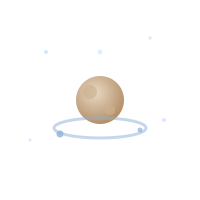
Dwarf Planets — Small Worlds, Big Stories
In 2006, astronomers agreed on a new category for worlds that orbit the Sun but share their neighborhood with other objects: dwarf planets. Pluto, Eris, Makemake, Haumea, and Ceres belong to this club.
The most famous dwarf planet — visited by New Horizons in 2015
A dwarf planet beyond Pluto, similar in size
Icy worlds in the Kuiper Belt
The largest object in the asteroid belt
Pluto is not the only dwarf planet — and it is far from the edge. Billions of icy objects circle the Sun out here, and comets that visit the inner Solar System began their long journeys from regions like this.
Where Does the Solar System End?
Even the Kuiper Belt is not the end. Beyond it lies a huge, spherical cloud of icy objects called the Oort Cloud, and eventually the point where the Sun's wind fades and interstellar space begins.
Only two human-made spacecraft, Voyager 1 and Voyager 2, have reached that edge so far — carrying golden records with sounds and pictures of Earth, messages in a bottle for any traveler who finds them.
You have now traveled from the heart of the Sun's family to its outermost frontier. That is the whole Solar System — a journey of about 9 billion kilometers, and you just crossed it in a few pages!
The Solar System does not end sharply — it fades. What else in life fades gradually rather than ending all at once?
Quick Check
What lies beyond the orbit of Neptune?
The Solar System does not end at Neptune. It fades through the Kuiper Belt, dwarf planets, and the distant Oort Cloud into the vast ocean of interstellar space.
Reflect
What You Discovered
- The Solar System fades — it does not end abruptly
- The Kuiper Belt holds icy worlds and dwarf planets like Pluto
- The Oort Cloud forms a distant shell around everything
- Voyager 1 has already reached interstellar space