Jupiter
Stop 8 of 12 · Outer Solar System
Jupiter
The giant of the Solar System — a world of swirling clouds and a storm larger than Earth.
Progress is saved privately in your browser.
Discover Jupiter — the largest planet, a gas giant with bands of cloud, a giant red storm, and dozens of moons.
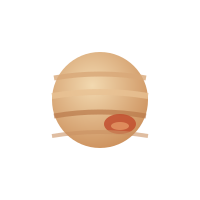
Leela's book shows a picture of Jupiter: creamy bands of cloud wrapped around a giant globe, with a huge reddish oval swirling near its middle. Next to it, a small dot labelled "Earth" for scale. The dot looks almost like a speck of dust.
"Manjari," she breathes, "that storm is bigger than our whole planet?"
What is that giant red spot? And why does Jupiter look so stripy?
A storm that has raged for centuries, and a planet made of gas! Here is a clue: when you stir milk into coffee, do you see swirls and streaks? Think about what stirring a whole planet of gas might look like.
Jupiter is a gas giant — a huge ball made mostly of hydrogen and helium, with no solid surface to stand on. Its colorful bands are layers of clouds whipped around by fierce winds. And the Great Red Spot is a giant storm — so big that Earth could fit inside it, and it has been spinning for at least 150 years, maybe longer.
A Planet of Extremes
Jupiter is the largest planet in the Solar System — more than twice as massive as all the other planets combined. About 1,300 Earths could fit inside it.
Yet for all its size, it spins faster than any other planet — one day on Jupiter lasts barely 10 hours. That rapid spin stretches its clouds into those long, sweeping bands.
- Order from Sun
- Fifth of the eight planets
- Approximate diameter
- 139,820 km
- Known moons
- 95
- Year length
- 11.9 Earth years
Jupiter's moon Ganymede is the largest moon in the Solar System — it is even bigger than the planet Mercury!
A Family of Moons
Jupiter has at least 95 known moons. The four largest were spotted by Galileo in 1610 — the first time anyone had seen moons circling another world. That discovery changed how we think about our place in the universe.
One of Jupiter's moons, Europa, is covered in a smooth shell of ice — with a hidden ocean of liquid water beneath it. Many scientists think it is one of the best places to search for life beyond Earth.
Jupiter acts like a giant shield for the inner planets. Its strong gravity catches or deflects many comets and asteroids that might otherwise head toward Earth.
Jupiter's gravity quietly protects the inner planets. What quiet forces protect you in your everyday life?
Quick Check
What is the Great Red Spot on Jupiter?
Jupiter is the largest planet — a swirling gas giant with banded clouds, a storm larger than Earth, and a family of nearly a hundred moons.
Reflect
What You Discovered
- The largest planet in the Solar System
- The Great Red Spot is a storm larger than Earth
- Nearly a hundred moons orbit Jupiter
- A gas giant — there is no solid surface