The Moon
Stop 6 of 12 · Inner Solar System
The Moon
Earth's constant companion — a world of reflected light, changing phases, and gentle tides.
Progress is saved privately in your browser.
Understand what the Moon is, why it changes shape, and how its gravity gently tugs at Earth's oceans.
It is a clear night, and the Moon is full and round — so bright that Leela can almost read by its light. She looks up, then down at the picture of Earth from space, then up again.
"Manjari," she says slowly, "is the Moon a planet? It looks like one."
Manjari fluffs her feathers. "Now there is a question worth staying up for."
Is the Moon a planet? And why is it round one night and a thin sliver another night?
Two lovely questions! Let me give you one clue each. First: does a planet have to orbit another planet? Second: what happens to your shadow when someone stands in front of your lamp?
The Moon is not a planet — it is a natural satellite, a world that orbits a planet, just as the planets orbit the Sun. The Moon orbits Earth.
And about its shape: the Moon is always round. What changes is how much of its sunlit side we can see. As the Moon travels around Earth, the Sun lights different parts of it, and we call those changing views the phases of the Moon.
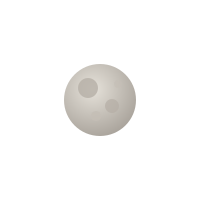
The Phases of the Moon
Over about 29.5 days, the Moon completes one full cycle of phases:
- New Moon — the Moon is between Earth and the Sun; we see the dark side, so it is nearly invisible
- Crescent — a thin sliver appears
- First Quarter — half of the Moon is lit
- Gibbous — more than half, but not full
- Full Moon — the whole sunlit face turns toward us
- …then the cycle repeats, growing thinner again
Stand in a dark room with a ball and a torch (a phone flashlight works!). Shine the torch on the ball and slowly walk around it. The "phases" you see are exactly why the Moon changes shape — you are seeing different amounts of its lit side.
A Gentle Pull on the Oceans
The Moon is close enough that its gravity tugs on Earth — most visibly on the oceans. That pull is what creates tides: the gentle rise and fall of the sea, roughly twice a day. When the Sun and Moon pull together, the tides are especially high.
The Moon in Numbers
Natural satellite of Earth
About 384,400 km away
About 29.5 days, new Moon to new Moon
About one-sixth of Earth's — you could jump six times higher!
The Moon always shows us the same face. It spins on its axis at exactly the same rate it orbits Earth — a gentle lockstep called tidal locking. The far side of the Moon was a complete mystery until spacecraft photographed it!
Why Does This Matter?
The Moon steadies Earth's tilt, which keeps our seasons gentle, and its gravity pulls the tides that shape coastlines and ocean life. It is also the stepping-stone humanity used to learn how to leave our planet.
Why do you think humans have dreamed of visiting the Moon for so long?
Quick Check
Why does the Moon seem to change shape through the month?
The Moon is Earth's natural satellite. It shines with reflected sunlight, cycles through phases every 29.5 days, and its gravity gently pulls our oceans into tides.
Reflect
What You Discovered
- Earth's natural satellite
- It shines with reflected sunlight
- Phases come from our changing view of the sunlit side
- Its gravity pulls the oceans into tides
- We always see the same face