Venus
Stop 4 of 12 · Inner Solar System
Venus
The brightest light in the evening sky — and the hottest planet in the Solar System.
Progress is saved privately in your browser.
Explore Venus — Earth's "twin" in size, but a world where thick clouds trap heat and turn everything upside down.
Leela is back at her window at dusk. Low in the west, a single point of light blazes brighter than any star.
"The evening star!" she says. "But Manjari, you told me stars make their own light. What is that?"
Manjari tilts her head. "That, little one, is not a star at all."
If it is not a star, what is it? It outshines everything in the sky!
A good clue: some planets are so close to us, and so good at reflecting sunlight, that they shine brighter than the stars. Now — which planet do you think it could be?
That brilliant "evening star" is Venus, the second planet from the Sun. It is covered in thick, creamy clouds that reflect sunlight brilliantly — which is why it glows so brightly in our sky. Only the Moon shines brighter at night.
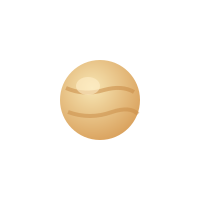
Earth's Twin — With a Terrible Secret
Venus is almost the same size as Earth, which is why it is sometimes called Earth's twin. But the resemblance ends there.
Its thick atmosphere is mostly carbon dioxide, and it traps heat so effectively that the surface simmers at about 465 °C — hot enough to melt lead. This is the greenhouse effect at its most extreme.
Even though Mercury is closer to the Sun, Venus is hotter! Its blanket of clouds and carbon dioxide traps heat far better than Mercury's bare rock ever could.
- Order from Sun
- Second of the eight planets
- Approximate diameter
- 12,104 km
- Known moons
- 0
- Year length
- 225 Earth days
Venus spins backward compared to most planets — and so slowly that its day is longer than its year!
A World Turned Upside Down
Most planets spin one way, but Venus spins backward — the Sun would rise in the west and set in the east. No one knows exactly why, though a long-ago collision is one idea.
And the pressure at its surface is crushing — about 90 times the pressure on Earth, similar to being 900 meters deep in the ocean.
Why Venus Matters to Us
Venus teaches us about our own planet. The same kind of greenhouse effect that bakes Venus exists on Earth too — but in a much milder form, thanks to our thin layer of heat-trapping gases. Understanding Venus helps scientists think about Earth's climate.
Venus shows what a runaway greenhouse effect can do. What small things can we do every day to protect Earth's atmosphere?
Quick Check
Why is Venus hotter than Mercury, even though Mercury is closer to the Sun?
Venus looks like Earth's twin in size, but its runaway greenhouse effect makes it the hottest planet in the Solar System.
Reflect
What You Discovered
- Venus is Earth's twin in size
- A runaway greenhouse effect traps heat
- It's the hottest planet — even hotter than Mercury
- It spins backwards, and its day lasts longer than its year